Chaospace 2025 Special Edition
In Collaboration with Apply Triangle
Magical Garden
Heading 3
Sunday, November 23, 2025 · 3:00 PM EST
The DiMenna Center for Classical Music, Cary Hall
450 W 37th St, New York, NY 10018


Chaospace 2025 Special Edition Concert Magical Garden, presented in collaboration with Apply Triangle, is an acoustic-electronic and multimedia performance featuring six works in total, including five world premieres.
The Magical Garden project is supported by the Foundation for Contemporary Arts (FCA).

Yanqi Chen is a composer, multimedia artist, and sound engineer whose work explores the intersection of instrumental performance, electroacoustic sound, and mixed media works. Drawing inspiration from visual art, social issues, nature, and personal experience, her practice extends from instrumental composition into experimental projects encompassing installations, virtual reality, and cross-disciplinary designs integrating light, motion, dance, real-time visuals, and sound spatialization. Her work has been featured at festivals and conferences including Académie internationale de création musicale avec nouveaux media, Creative Dialogue, NSEME, SEAMUS, and SICPP, among others. She is currently a doctoral fellow in Composition at Columbia University.
The Fallen Leaf Falls
This piece extends my ongoing exploration of sound, memory, and the recollection of time. It grew out of a small memory from my summer in Beauchêne — one I repeatedly revisited, with each return subtly altered as emotions shifted, images blurred, and details fell out of alignment. The score invites the performer to repeat and vary sonic fragments according to their own subjective recall. In doing so, the work treats each instant as double, with perception unfolding in the present and recollection shadowing it. Through these repetitions and recollections, the work stages the act of remembering itself: fragments are retrieved, re-ordered, and re-voiced, so that the past is reconstructed while the present is unfolding. As the title suggests, a leaf falls. It has fallen. It falls because it has already fallen.
< Tout moment de notre vie offre donc deux aspects : il est actuel et virtuel, perception d’un côté et souvenir de l’autre. >
— Henri Bergson, “Le souvenir du présent et la fausse reconnaissance”

Kim Hedås is a composer of orchestral, vocal, chamber, and electroacoustic music. Her music has been commissioned and performed by prominent orchestras, ensembles and soloists in Sweden and internationally. Her work also includes electroacoustic works and site-specific music installations. Her compositions have recently been performed internationally and at numerous festivals and venues in Sweden. Kim Hedås is a professor of composition at Kungliga Musikhögskolan (Royal College of Music in Stockholm) and holds a PhD from the University of Gothenburg.
The new piece, titled Woods, was written for bass flute, bassoon, piano, and electronics. As the piece progresses, three different musical materials intertwine and separate. Consisting of sixteen movements, the piece features transitions that either abruptly stop a phrase or softly lead the music into calmer atmospheres. These transitions combine fragments and moods from earlier sections to create a new, kaleidoscopic arrangement.
The three musicians are given constantly changing roles. The same applies to the electronic part, which is composed and spatialised for four channels. Resonances, swirls and shadows move through time, connecting the various sections of the piece and expanding the sense of space.
The music focuses on the darker timbres of the instruments, with the electronics acting as a counterpart in shadow to the lowest register of the piano. Occasionally, glimpses of brighter light also come into play, opening upwards.
Woods

Chen Shuhe Yue (Yue Chen) is a composer, soprano, and interdisciplinary artist. Her practice combines instrumental composition, theater, movement, and sound installation into immersive creations that interlace acoustic, electroacoustic, and multimedia dimensions. Her music explores social themes related to mental health, illness, and marginalized experience through an objective yet empathetic sonic language that invites reflection and accessibility. With a strong dramaturgical sensibility, she expands the expressive scope of music by shaping sound into spatial and sensory experiences. Her works have been presented in over twenty countries and in collaboration with ensembles such as JACK Quartet, Ensemble PHACE, and ICE. She is currently a Doctoral Fellow in Composition at the Manhattan School of Music.
Hyper Hypo
Hyper Hypo is based on sensory and behavioral patterns commonly associated with autism. These include shifts between heightened sensitivity and reduced responsiveness, an intensified focus on small or peripheral details, the use of repetitive actions to maintain a sense of stability, and periods of withdrawal when external input becomes overwhelming. The piece adopts these characteristics as structural and gestural materials. Abrupt changes in density, sustained attention to limited material, recurrent patterns, and extended quiet yet high-tension sections align with these perceptual and behavioral states. The work does not attempt to explain or interpret them, but shapes its musical trajectory according to the fluctuations, transitions, and internal tensions inherent in these patterns.

Tianyu Zou is a composer and multimedia artist whose practice merges experimental electronic music, moving image, and socio-cultural inquiry through immersive audiovisual experimentation. His work integrates instrumental virtuosity, electronics, visuals, and lighting, using forms reminiscent of urban memes to explore the complex relationship between the internet and contemporary society. His projects have been presented at festivals and institutions, including GMEM (FR), EMS (SE), Liminal/Crossroads (AT), Musikfestival Bern (CH), MIXTUR (SP), Kalvfestivalen (SE), IRCAM, C-Lab (TW), Rümlingen (CH), and Lucerne Festival. He has been awarded several grants from the Nicati de-Luze Foundation and Ernst von Siemens Grants. He is currently pursuing his Doctorate in Composition at the University of California, Berkeley.
Fungi possess a distinctive capacity to connect living beings, weaving a “Wood Wide Web” through their mycelial networks. In an era when those strategies of「 ... ex machina 」are all too familiar, the composer of this work does not deliberately attach explicit intentions or interpretations. Instead, the piece places each medium in relation to its own reality and to the forms, syntax, and sounds through which it appearsto us.The tension between a musical language shaped by the composer’s personal, nostalgic experiences, where the work is rooted, and the other media challenges our perception, inviting us to understand ambiguity as a space of possibility. Through the performance of the three musicians, live electronic music, and visuals that construct a simulated mycelial network, the work guides us into deeper layers of perception and potential meaning.
Mycelium ex Machina

Jack Herscowitz is a Chicago-based composer, improviser, and sound artist working across experimental music and art practices. Described as “the slow descent of the sun at twilight” (A Closer Listen), his current work centers around commitment to unadorned musical materials to reveal their complexities, exorcisms of mass-produced tech, interruptions which peel back the curtains on cultural practices of art making, noise as an activation of the full body, and relational non-hierarchical webs of listening. His practice spans instrumental composition, dramaturgy, electroacoustic improvisation, installation, landscape film, object performance, sampling, text, and communal sound making. He is currently pursuing a PhD in Composition and Sound Practices at the University of Chicago.
a little moth slipped through the cracks
I am lost in a hazy woods. All I recognize is a dead elderberry shrub, in the center of a grove of white ash trees. I try to leave. But, every time I make my way out of the grove, wandering deeper into the forest, I manage to find my way back: a clever Möbius strip prison. Always, as the ash trees fade into a grey mist behind me, they re-materialize in the distance, until I am back where I started. I take this as a sign, and investigate the ashen shrub: approaching carefully, until I am at its doors, gazing deeper and deeper into its withered bramble. And, there it is! A tiny moth, delicate, but lively, nestled at the base of what was once a verdant home. I realize that this is what I was supposed to find here. And how peculiar the woods look now!
**NOTE: this piece employs the psychoacoustic effect of difference tones: tones produced by your ears which sound at the difference of two pitches simultaneously sounding (e.g. 400 Hz and 300 Hz produce the difference tone of 100 Hz). For these tones to be perceptible, this piece must be played at a high volume. In the words of Maryanne Amacher: "Do not be alarmed! Your ears are not behaving strange or being damaged! ... these virtual tones are anatural and very real physical aspect of auditory perception, similar to the fusing of two images resulting in a third three dimensional image in binocular perception." If this is an uncomfortable sensation/volume, you are absolutely free to use ear protection, knowing that this will make the difference tones much harder to hear.**

Apply Triangle is a NYC-based electroacoustic trio founded by Yoshi Weinberg (flutes), Tyler Neidermayer (clarinets), and Jixue Yang (piano).
Blending live electronics, multimedia, and socially engaged themes, the trio has performed internationally at the SinusTon Festival (Germany), NYU’s Pulsing and Shaking Macro Festival, Manhattan School of Music, and the University of Pennsylvania, and led residencies at Bowling Green State University and the University of Florida. Their first Call for Scores led to Oxalis Triangularis, a three-album collection of 33 remotely recorded works released on cmntx records in 2024, reviewed by I Care If You Listen and Neon Music UK for its innovation and artistic breadth. A recipient of Chamber Music America’s Ensemble Forward Grant in 2021, Apply Triangle continues to champion bold new voices in electroacoustic chamber music.
Special guest bassoonist David Nagy will be joining us for the Magical Garden concert in November 2025.
Pronouns: They/Them
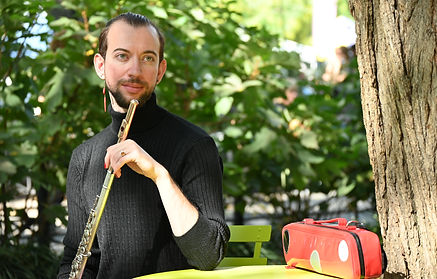
Yoshi Weinberg (they/them) is a NYC-based flutist, harpist, and composer. Lauded for their “sublime tone” and “creative interpretation and technical virtuosity” (I Care If You Listen), Yoshi is a dedicated performer of contemporary and experimental works. Yoshi has performed as a soloist across North America and Europe including Carnegie Hall (NYC), Walt Disney Concert Hall (LA), the Fitzgerald Theater (St. Paul, MN), among many others. They currently are Artistic Director of InfraSound, and is
founding member and flutist for Apply Triangle, InfraSound, and Aqueeressence. An active freelancer, Yoshi performs regularly with Talea, Contemporaneous, and ChambeQUEER, and as a guest artist with Ensemble Signal, the Da Capo Chamber Players, Zeitgeist, and many others. They currently sub on Reed 1 for The Lion King on Broadway. Additionally, Yoshi served as Artistic Director of the Minnesota new music ensemble RenegadeEnsemble for the 2017-2018 season. As a composer, Yoshi’s compositions have been described as “a stunning compositional display of polyphony and texture” (ICIYL) and “transcendent, emotional, and intimate” (Sparks and Wiry Cries). Their works have been premiered by Contemporaneous, ChamberQUEER, InfraSound, e(L)ement duo, the dream songs project, and RenegadeEnsemble, and have been featured on Minnesota Public Radio and at the American Harp Society Summer Institute. Yoshi is currently studying their DMA in Flute Performance at CUNY Graduate Center, studying with Robert Dick. They received their MM in Contemporary Performance from Manhattan School of Music with Tara O’Connor, and their BM in Performance from Saint Olaf College with Catherine Ramirez.
Pronouns: She/They
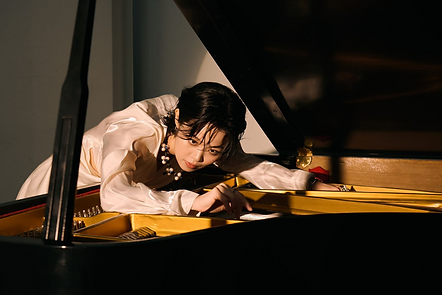
New York-based pianist Jixue Yang is known for her genre-defying performances that explore sound, gesture, and identity through experimental and electroacoustic music. She was the first Chinese citizen admitted to the Manhattan School of Music’s Contemporary Performance Program, where she is currently completing her Doctor of Musical Arts. Her principal teachers include Phillip Kawin, Margaret Kampmeier, Solomon Mikowsky, and Inesa Sinkevych.
Yang has received the Gold Award at the Singapore International Music Competition and was named Pianist of the Season at the Ad Libitum Piano Competition, with multiple top prizes recognizing her interpretations of 20th- and 21st-century repertoire. She has performed internationally at venues including Akoesticum (Netherlands), Hochschule für Musik Leipzig and Dresden, Opera America’s Marc A. Scorca Hall, DiMenna Center, and the Natalie L. Haslam Music Center. Her residency and festival appearances include SinusTon Festival, Nief-Norf, Cortona Sessions, Creative Dialogue IX, NYU’s Pulsing & Shaking Festival, and the Negentropy Nexus by Absonus Lab.
A dedicated educator, Yang has taught at Manhattan School of Music, Columbia University, and through community programs such as the Misty Copeland Foundation’s Be Bold initiative. Her teaching focuses on inclusivity, critical listening, and experimental techniques. She has presented lectures and workshops at institutions including the University of Florida, University of Pennsylvania, Bowling Green State University, and Hochschule für Musik Franz Liszt Weimar, often centering underrepresented voices and evolving technologies in contemporary music.
Pronouns: He/Him
Dávid Ádám Nagy is a Hungarian-born protodisciplinary artist, contemporary bassoonist, and creative entrepreneur whose work dissolves the boundaries between disciplines — not to erase them, but to discover the intersections that connect them.
A graduate of Bard College and The Juilliard School, Dávid is recognized for performances that unite emotional and conceptual depth with resonance and virtuosity, creating concert experiences that linger far beyond sound. He approaches performance as a living of experiment — an encounter between structure and spontaneity, attention and intuition.

Dávid has appeared as a soloist and chamber musician at MoMA, the Budapest Spring Festival, White Nights in St. Petersburg, Lorin Maazel’s Castleton Festival, the Prototype Festival, and the Bard Music Festival. He is a member of contemporaneous, a renowned ensemble devoted to performing the most exciting music of today. His artistic collaborations have extended to institutions including The Clark Art Institute, the Hungarian Academy of Sciences, Columbia University, NYU, the Liszt Institute, and the John Cage Trust.
Beyond music, Dávid’s work unfolds across visual art, writing, and design. His practice seeks to tune creativity into one living form — where art, science, and philosophy resonate as facets of the same curiosity: what it means to be alive and aware.

x
